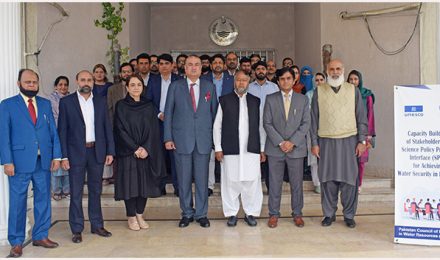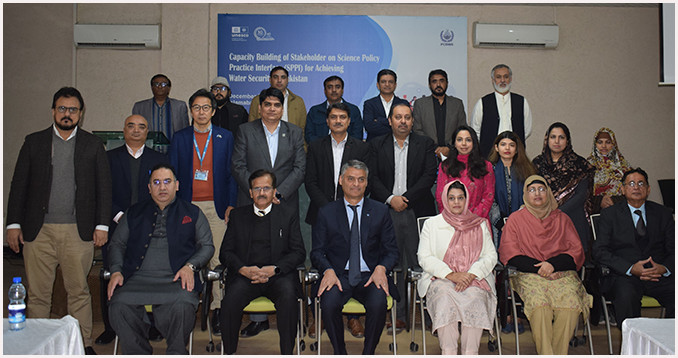
The project on Capacity Building of Stakeholders on Science Policy Practice Interface (SPPI) for Achieving Water Security in Pakistan has been concluded today in PCRWR Islamabad (UNESCO-PCRWR) on December 03, 2025
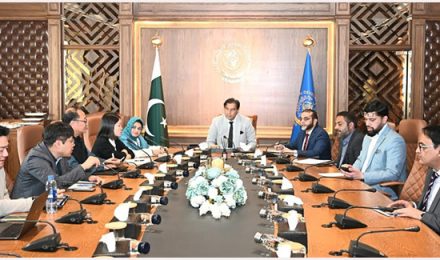
The Pakistan Council of Research in Water Resources (PCRWR), in collaboration with UNESCO, organized the final capacity building workshop on strengthening the Science Policy Practice Interface (SPPI) for achieving water security in Pakistan. The workshop took place on 3rd December 2025 at PCRWR, Islamabad, with active participation from academia, researchers, students, and NGOs. The event provided a platform to discuss emerging water challenges in the context of climate change and to explore integrated, evidence-based solutions.
Dr. Hifza Rasheed, Director General PCRWR, welcomed the participants and emphasized the urgency of engaging diverse stakeholders to address Pakistan’s water security challenges. She underscored that SPPI initiatives help build a shared understanding between researchers, policymakers, and practitioners. She encouraged active participation and highlighted that collaborative, science-driven approaches are vital for achieving sustainable water management in the country.
Mr. Fuad Pashayav, Director UNESCO Pakistan, appreciated PCRWR’s commitment to promoting research-informed policy development and strengthening national capacity for water security. He highlighted UNESCO’s strong focus on bridging science and practice, particularly in climate vulnerable countries like Pakistan. He noted that the workshop represents an important step toward deeper knowledge exchange, innovation, and resilience building. He confirmed that the UNESCO Pakistan Office will continue to support initiatives that strengthen the science-policy-practice interface and advance sustainable water management efforts in the country.
Mr. Ahmad Kamal Ex-Chairman Federal Flood Commission (FFC) and Chief Engineering Adviser to Ministry of Water Resources, delivered a keynote speech by highlighting the importance of the integration of science into policy and practice. He emphasized the need of effective collaboration and integration of science in the policies keeping in view the complex water resources management issues.
During the technical session, Engr. Muhammad Kashif Manzoor, Deputy Director PCRWR, delivered a comprehensive presentation focused on fostering stronger collaboration among scientists, policymakers, and on-ground practitioners. He highlighted how the SPPI framework enhances communication, strengthens capacity, and encourages integrated approaches to managing water resources. Participants praised the clarity, depth, and relevance of his session, noting that it inspired them to align their research with practical, solution-oriented actions that contribute meaningfully to national water security objectives.
Engr. Asghar Ali Halepoto, Chief Water at the Ministry of Planning, Development and Special Initiatives, (Chief Guest for the technical session) thanked the participants for their active engagement. He shared key government initiatives focused on improving water governance, strengthening data-driven decision-making, and advancing integrated resource management. He emphasized the need for continued collaboration among institutions to tackle emerging water challenges. He also appreciated PCRWR and UNESCO for organizing the workshop and reaffirmed the Government’s commitment to enhancing Pakistan’s water security.
In conclusion, Engr. Muhammad Kashif Manzoor thanked all participants for their active engagement and thoughtful contributions throughout the workshop. He reaffirmed PCRWR’s firm commitment to strengthening the science-policy-practice nexus and advancing collaborative approaches to water management. He expressed confidence that the partnerships and ideas generated during the session would continue to inspire collective action toward ensuring sustainable water security in Pakistan.