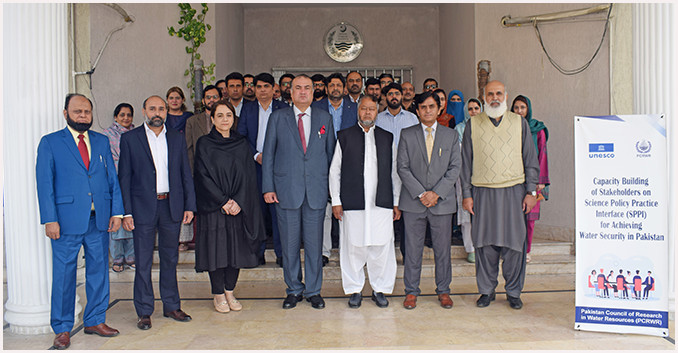
Capacity Building Workshop on SPPI for achieving Water Security in Pakistan (UNESCO funded), at PCRWR’s Regional Office Lahore on November 20, 2025
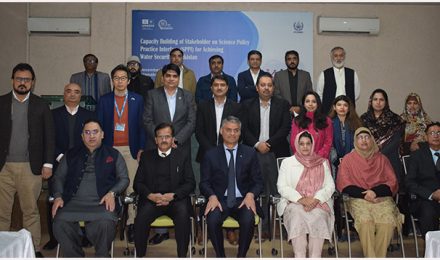
PCRWR in collaboration with UNESCO organized a capacity building workshop on strengthening the Science Policy Practice Interface (SPPI) for achieving water security in Pakistan commenced with an engaging session held on 20th November 2025 at the PCRWR Regional Office, Lahore. The event brought together representatives from academia, researchers, students, Govt. Departments, NGOs and Civil Services Academy (CSA), to deliberate on the country’s pressing water challenges in the wake of climate change.
Engr. Faakhar Raza, Regional Director, PCRWR Lahore, welcomed all participants and highlighted the urgent need for broad multi-stakeholder collaboration to tackle Pakistan’s water security challenges. He noted that workshops like this are essential for strengthening alignment among researchers, policymakers and field practitioners, and encouraged participants to actively engage in shaping innovative, workable solutions.
Engr. Muhammad Kashif Manzoor, Deputy Director, PCRWR, delivered a detailed presentation underscoring the importance of strengthening collaboration between scientists, policymakers, and practitioners. He highlighted that the SPPI framework aims to bridge the existing communication gap between research and policy by promoting knowledge exchange, capacity building, and integrated approaches to water resource management. His presentation was engaging and thought provoking, effectively emphasizing the importance of strengthening the science-policy-practice interface. It received excellent feedback from participants, who felt motivated to align their research with actionable solutions that support water security efforts in Pakistan.
Participants actively engaged in the discussion and offered constructive feedback on the SPPI. Dr. Muhammad Aslam (Professor, University of Lahore) emphasized the need for a comprehensive strategy to sensitize politicians and the bureaucracy on the importance of water, as well as their active role in water governance and management. Engr. Tariq Yameen (Chief Chemist, Water Resources Zone, PID, Lahore) informed the forum that the WRZ has geo-tagged 1.4 million tubewells across Punjab and maintains extensive groundwater monitoring data. He also highlighted the existing gaps in coordination between end users and policymakers. Dr. Ghulam Zakir Hussain Sial (Director, IRI, PID, Lahore) underscored the importance of establishing village level mechanisms for water management with the participation of all stakeholders, including local communities. He also offered support for providing groundwater level and quality data collected through 5,000 piezometers installed across Punjab. Engr. Masood Ahmed (Assistant Professor, CEWRE, UET Lahore) stressed that university research should be issue based and aligned with policy frameworks that ensure legal backing and effective implementation. On behalf of CEWRE, he extended full support for collaborative, issue driven research initiatives. Engr. Mushtaq Ahmed Gill (CEO, SCAN) suggested that academia should take the lead in issue based research and emphasized the need for strengthened coordination between academia and industry. Mr. Mohsin Ali (Punjab Rural Support Program, Lahore) also advocated for the active involvement of all stakeholders, particularly local communities in water management.
Moreover, Dr. Muhammad Irshad (Former Dean, Faculty of Agricultural Engineering, UAF) noted that both technical and coordination gaps persist, and he stressed that policy development must be grounded in research. Syed Babar Zulfiqar (Additional Director, Civil Services Academy, Lahore) highlighted the need to raise awareness about water conservation and management at all levels of society. He further recommended initiating a national level dialogue with legal backing to address inter-provincial water issues and emphasized that consensus building should precede the construction of new dams.
In conclusion, Engr. Faakhar Raza expressed his sincere appreciation to all participants for their active involvement and constructive contributions. He reaffirmed PCRWR’s commitment to advancing the science-policy-practice linkage and conveyed confidence that the collaborative spirit demonstrated during the workshop will continue to drive joint efforts toward achieving sustainable water security in Pakistan.