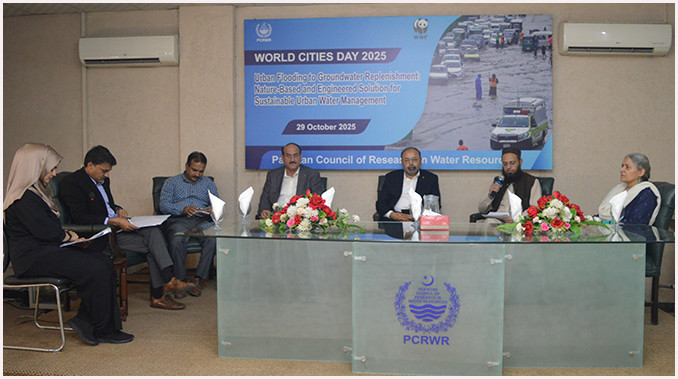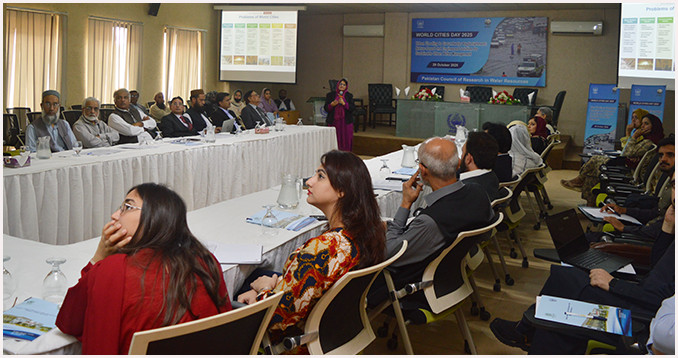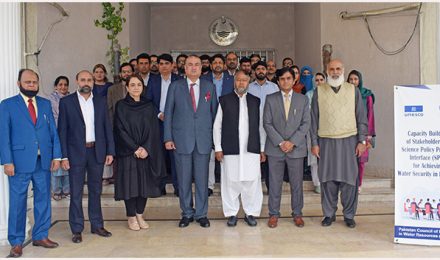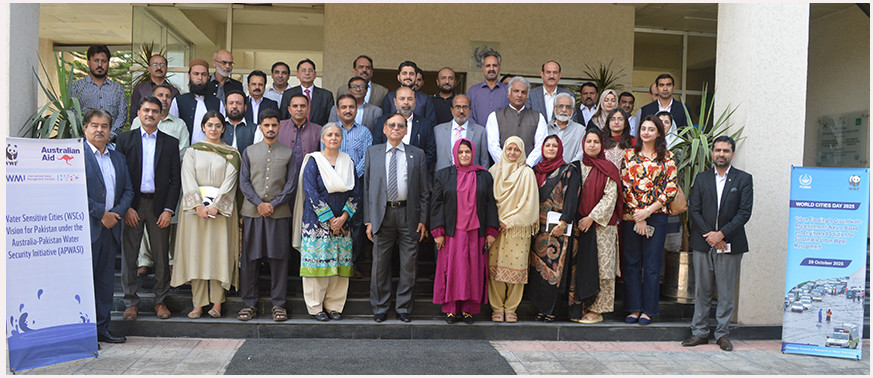
workshop titled “Urban Flooding to Groundwater Replenishment: Nature-Based and Engineered Solutions for Sustainable Urban Water Management” on October 29, 2025, at the NCBI Auditorium, PCRWR Headquarters, Islamabad
Pakistan Council of Research in Water Resources (PCRWR), in collaboration with WWF-Pakistan, organized a joint workshop titled “Urban Flooding to Groundwater Replenishment: Nature-Based and Engineered Solutions for Sustainable Urban Water Management” on October 29, 2025, at the NCBI Auditorium, PCRWR Headquarters, Islamabad. The event was held in connection with World Cities Day and brought together a wide range of stakeholders including CDA, WASA, WSSP, Punjab Irrigation Department, UN-Habitat, Sheharsaz, Federal Flood Commission, PARC, PMD, IRSA, Marriott Hotel, Sungi Development Foundation, IWASRI, and others.
The workshop focused on transforming urban flood challenges into opportunities for groundwater recharge through both nature-based and engineered interventions.
Dr. Hifra Rasheed (Director General, PCRWR) highlighted critical challenges facing Pakistan’s major cities such as aging infrastructure, governance gaps, and declining water quality. If the current pace continues then it will be very difficult to achieve the SDG goals by 2030.
Mr. Masood Arshad (WWF) emphasized the power of long-term partnerships, citing successful restoration examples like the revival of mangroves and the Sindh dolphin population. He stressed that collaborative and sustained efforts can reverse groundwater depletion in the future.
Mr. Javaid Ali Khan (UN-Habitat) reaffirmed support for initiatives addressing groundwater issues, pledging collaboration with NDMA, Metro, and PCRWR.
Mr. Dilshad Arshad (PCRWR) discussed the rapid rise in groundwater extraction and the urgent need to balance abstraction with recharge. He shared insights on the implementation of recharge wells, rooftop harvesting, and permeable pavements, adding that Pakistan’s National Water Policy already supports such measures. He also noted that CDA and PEC have approved new building codes mandating rainwater harvesting, while EPA has made such interventions obligatory.
Dr. Zakir Sial (Director Punjab Irrigation Research Institute) presented ongoing groundwater recharge projects, including 40 models under development—17 completed and 23 in progress. He emphasized converting floods into opportunities by capturing excess flows through recharge wells and infiltration systems.
During the panel discussion, experts underlined the need for better urban planning, maintenance of drainage infrastructure, community-based early warning systems, and data-driven decision-making. Engineering solutions such as recharge wells and infiltration ponds were presented as practical, scalable interventions to enhance groundwater sustainability.
The workshop concluded with a shared vision: turning urban flooding into an opportunity for groundwater replenishment, ensuring sustainable, resilient, and water-sensitive cities for future generations.